
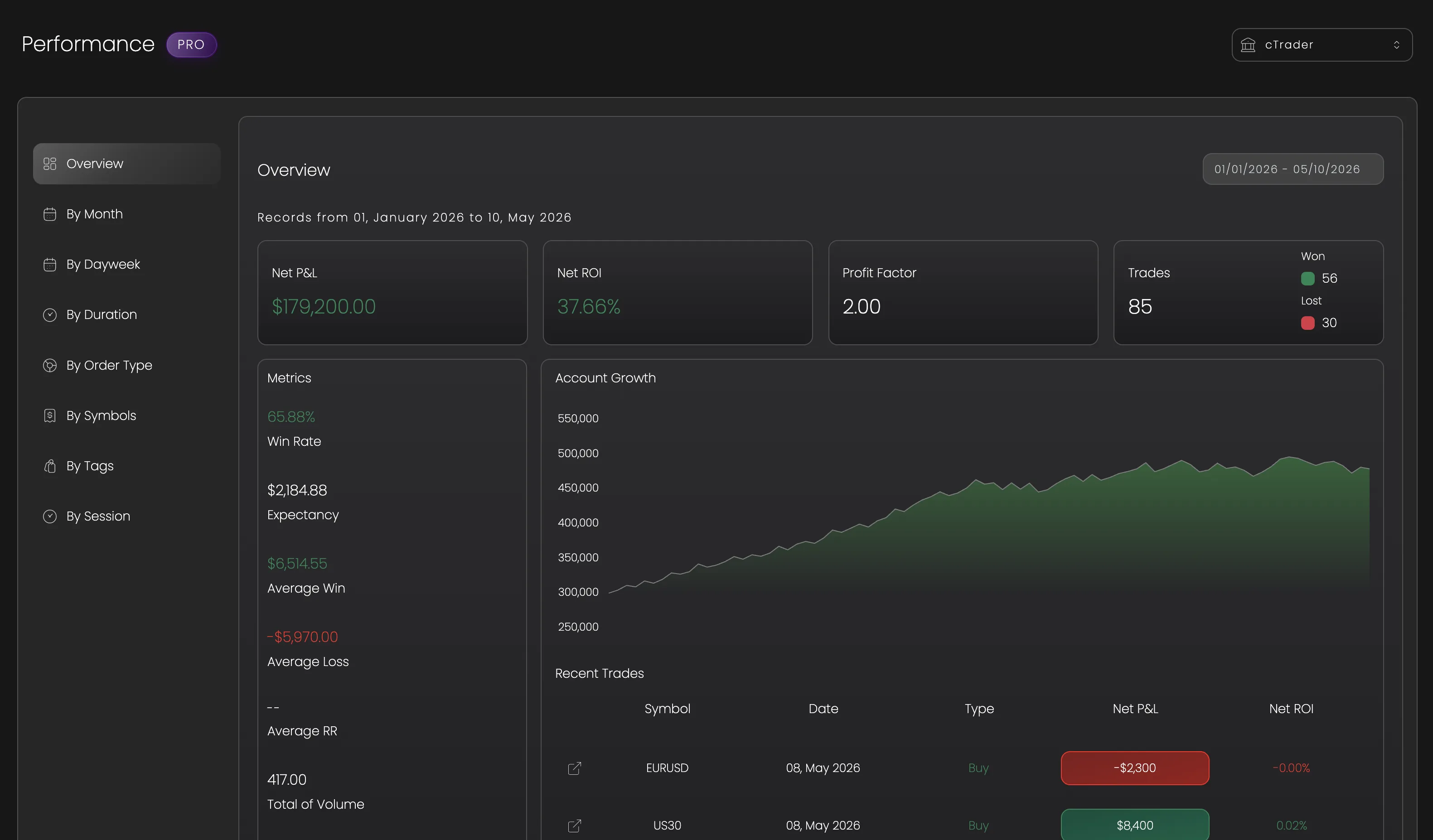
The 1:3 risk/reward ratio is the most repeated piece of advice in trading, and it is easy to see why. The maths is seductive: if every winner pays three times what every loser costs, you only need to be right 25% of the time to break even. Win a third of your trades and you are printing money. So you adopt it, you commit to it, and months later your account is still going the wrong way. The ratio was supposed to be the answer. What happened?
The uncomfortable truth is that a risk/reward ratio is a plan, not a result. The number you write down before a trade and the number the trade actually delivers are two different things, and the gap between them is where most accounts quietly die. Here are the four reasons your real R:R is not the one you planned, and what to do about it.
Quick refresher: Risk/reward compares what you put at risk against what you aim to win. Risk 1 to make 2 and your ratio is 1:2. You can work any ratio and see the exact win rate it needs with the free risk/reward ratio calculator.
This is the big one. You set a stop and a target before entry, so on paper the trade is a clean 1:3. Then the trade goes live and you are no longer a planner, you are a participant. Price stalls just short of target and you take "most of it" early. A winner pulls back to breakeven and you close it green rather than let it come back. A loser drifts past the stop because you widened it "just this once."
Every one of those decisions shaves the realised ratio. The planned trade was 1:3. The trade you actually booked was 1:1.4. Do that consistently and you are running a 1:1.4 system while believing you are running a 1:3 system, and budgeting your win rate accordingly. That mismatch alone is enough to turn a theoretically profitable approach into a slow loser.
The trap: Cutting winners early feels responsible. It locks in profit and it feels disciplined. But a trader who plans 1:3 and realises 1:1.3 has not been disciplined. They have been running a different, worse system without knowing it.
Our free Excel journal auto-calculates win rate, profit factor, expectancy and equity curve from one row per trade. The gap between the R:R you planned and the one you actually got stops being invisible.
Get the free templateThe seductive maths assumes you can hold your win rate steady while you stretch your target. You cannot. A target three times further away is, by definition, hit less often. Pushing for a bigger reward almost always lowers the hit rate, and beyond a point it lowers it faster than the bigger reward compensates for.
This is why "just aim for higher R:R" is incomplete advice. The ratio and the win rate are two ends of the same lever. Here is the win rate each ratio needs just to break even, before costs:
The number that matters is not the ratio on its own and not the win rate on its own. It is whether the pair of them, together, produces a positive expectancy over a large sample. A 1:3 ratio with a 20% real win rate is a losing system. A 1:1.5 ratio with a 55% win rate is a strong one.
The textbook 1:3 ignores the spread, commission and slippage on every single trade. Those costs are paid in full whether you win or lose, and they are paid against your risk unit, not your reward unit. On a tight stop strategy they are not a rounding error. They can turn a paper 1:3 into a real 1:2.4 before you have made a single discretionary mistake.
The smaller your stop relative to the spread, the more brutal this is. Scalpers running "1:3" on a five pip stop with a one pip spread are often running closer to 1:2 in reality, and that is on their best behaviour.
A 1:3 system that genuinely wins 30% of the time is profitable over a large sample. But 30% also means losing streaks of eight, ten, twelve trades in a row are not bad luck, they are statistically expected. The maths survives that. Most traders do not.
What actually happens during the streak is the damage. The trader who was perfectly happy at 1:3 starts taking marginal setups to "get a winner on the board," moving stops to avoid yet another loss, and sizing up to recover faster. Every one of those reactions degrades the realised ratio further, which makes the streak last longer, which intensifies the reaction. A high ratio with a low win rate is mathematically sound and psychologically punishing, and the psychology is what shows up in the account.
You cannot fix a number you cannot see. The single most useful thing you can do is stop trusting the ratio you intended and start measuring the ratio you actually booked. That means looking at real entry and exit fills across hundreds of trades, not the plan you had in your head at entry.
This is exactly the kind of question a trading journal answers, as long as the data is complete and accurate. Once every trade is captured automatically, you can ask the questions that matter:
For most traders who run this analysis for the first time, the realised ratio is a genuine shock. The plan said 1:3. The account has been quietly trading something closer to 1:1.3 for months. Nothing about the strategy was broken. The execution was.
Tracker Fx syncs your cTrader, Bybit, OANDA or MetaTrader trades automatically and calculates the realised R:R of every trade, paired with win rate per setup, so you can see the gap between the plan and the result.
Start Free TrialThe fix is not "try harder to hit 1:3." It is to close the gap between the planned ratio and the real one, and to make sure the ratio you genuinely run is paired with a win rate that makes it positive.
Track the R:R of closed trades from actual fills. Compare it to what you planned. The size of that gap is your single most important number, and most traders have never looked at it.
A ratio means nothing alone. Check expectancy: realised R:R and real win rate together. If that pair is negative, the strategy is losing no matter how good the planned ratio looks.
If the gap comes from cutting winners early, the entry is fine and the exit rule is the leak. Define exits in advance and treat moving them as a logged, reviewed exception, not a reflex.
Subtract spread and commission from the ratio before you decide a strategy is viable. A plan that only works at a frictionless 1:3 does not work.
A 1:3 risk/reward ratio is not a strategy and it is not a guarantee. It is a target, and the distance between that target and what you actually book is the real story of your trading. The traders who make a high ratio work are not the ones with the most discipline at the moment of entry. They are the ones who measure the realised number honestly, pair it with their true win rate, and fix the execution gap before it compounds.
The ratio was never the problem. The belief that the planned ratio is the real one is. Measure what you actually do, run the numbers with the risk/reward calculator, and let the data, not the plan in your head, tell you whether your edge is real.
We use essential cookies to run the site and analytics cookies (Google Analytics) to understand what's working. You can accept or reject. See our Privacy Policy.
 Tracker Fx Team