
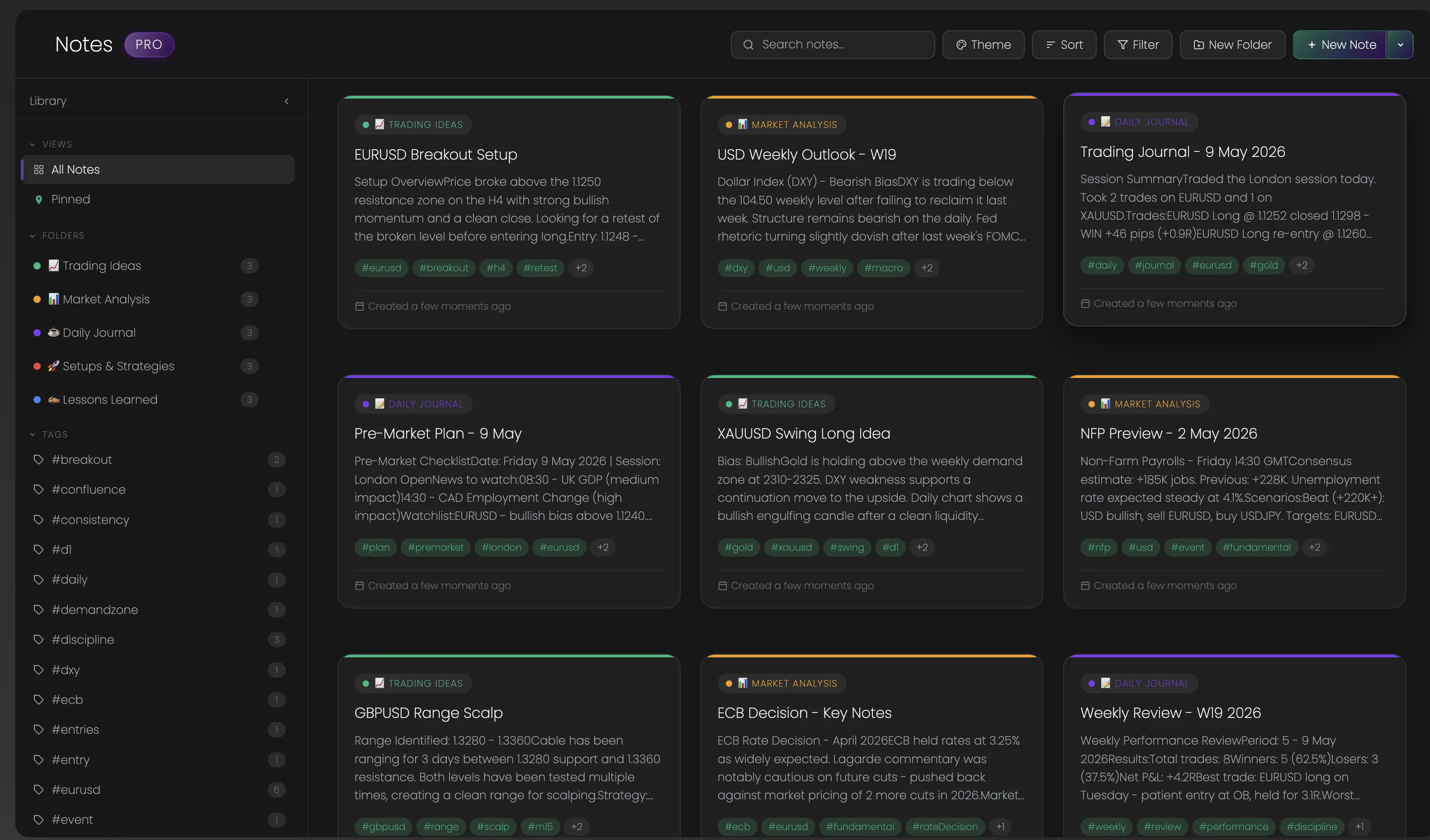
Every trader knows they should review their week. Almost none do it consistently. The reason is not laziness, it is design: most "weekly review" templates ask for 45 minutes, a spreadsheet, and a state of mind that traders rarely have on a Friday evening. The template here is built for the opposite: 15 minutes, no spreadsheet, no soul-searching - and it ends with one specific decision for next week. Anything more is optional, anything less is not really a review.
What follows is the exact 5-step process, in the order to do it, including what to skip and what most traders get wrong. It assumes your trades are already logged somewhere - if they are not, that is the first thing to fix, because no review can outrun missing data.
The case for short reviews is empirical, not aesthetic. Long reviews stop happening: the trader who blocks out an hour on Saturday morning will do it for two weeks and then quietly drop it. A 15-minute review survives a holiday week, a tired week, a losing week - the exact weeks that benefit most from being reviewed.
It also forces the review to be about decisions, not data. Fifteen minutes is not enough time to drown in detail, which means it has to be spent on what matters: where did the money come from, where did it leak out, and what changes next week as a result. That is what reviews are supposed to produce. Two hours of charting screenshots and writing prose does not produce decisions any faster than 15 focused minutes does.
The premise: if your review is not ending with one specific change for next week, it is not a review, it is a diary. Diaries are fine. Reviews are different.
This is the part that breaks most reviews. The clock starts when you sit down with a clear picture of the week. If you spend the first 10 minutes pulling P&L, tagging trades and reconciling the broker statement, the review never happens.
You need three things, ready and current:
If you keep a manual journal, the prep is the bottleneck. The 15 minutes turns into 90 because most of it is data entry. An automated journal that syncs from the broker is what makes the short review work - the data is already there on Friday afternoon, indexed and tagged, and the review is purely about reading it.
The order matters. Each step builds on the one before, and the last step is the only one that has to produce an output. The middle ones are inputs to the last one.
Look at each defined setup separately, not aggregate P&L. Which setups made money, which lost, which broke even. Total P&L hides too much: a great setup can carry a terrible one to a flat week, and you would not know.
What to write down: "Setup A: +3R / Setup B: -1.5R / Setup C: flat." Three numbers, not a paragraph.
Find the worst trade of the week by R-multiple - not by dollar, by R. Open it. What was the setup? Was it a valid trade that lost (which is fine), or was it a process break - a chase, a revenge trade, a moved stop, an unplanned entry?
The question: "Would I take this exact trade, this exact size, again with what I knew at the time?" If yes, it was a valid loss. If no, it goes in the bucket of trades to actively prevent next week.
Find the best trade by R-multiple. Same exercise in reverse: was it a clean execution of a setup you can replicate, or was it luck - a bigger move than your rules anticipated, a position you held longer than planned, a market that was unusually kind?
The question: "Is this trade copy-paste-able into next week if a similar setup appears?" If yes, you have a confirmation of an edge. If it was luck, do not internalise it as skill.
Scan the rest of the trades for a single repeated pattern. Not five patterns - one. Most traders find the same handful repeated weekly: late-session entries, trades sized up after wins, stops moved on indices but not on forex, every loss happening in the first 30 minutes of the session.
What to write down: one sentence. "Pattern: 4 of 5 losses came in the first 30 minutes of the London open." That is it. Save the analysis for when the same pattern appears for a third week in a row.
The whole review collapses into this. Looking at steps 1 to 4, pick exactly one concrete change for next week. Not a goal. Not an aspiration. A rule.
Bad: "Be more patient." Good: "No new positions in the first 15 minutes of the London open." Bad: "Size better." Good: "Maximum risk per trade is 0.75% until I have 30 more trades on Setup B." The decision has to be testable: by next Friday, you can say yes or no whether you kept it.
The clock: 3 minutes per step, 15 total. If a step is taking longer, you are over-analysing. Cut it and move on. The output is one written decision, not five.
Our free Excel journal auto-calculates win rate, profit factor, expectancy and your equity curve. Fill in one row per trade and the weekly review answers itself.
Get the free templateThree failure modes show up consistently. Catching them is most of what keeps a review honest.
A bad week feels worse than the data says it was; a good week feels better. A trader who reviews when angry will find evidence the strategy is broken; the same trader reviewing on Sunday will find it acceptable. Look at the numbers first, only then the feelings.
One week is not a sample size. Changing the strategy after a -2R week is exactly how curve-fitting happens to a live system. The threshold for changing a rule should be a pattern that repeats across 3 or 4 review cycles, not a single bad Friday. See risk-reward ratio - why a good one can still lose money for the related trap.
The review ends with "I should be more disciplined" or "next week I will be patient." Those are not decisions, they are vibes. A review without one concrete, testable change for next week is a journal entry, not a review - and a week of journal entries does not move an equity curve.
The skip trap: the worst weeks are the ones that need reviewing most. The temptation to skip because "I already know what went wrong" is exactly when a review pays the most. Skip the review for two consecutive bad weeks and the third one is almost guaranteed.
Four weekly reviews per month produce four written decisions. Once a month, spend an extra 10 minutes looking at those four decisions together. Did you keep them? Did the change help? Are any of them now permanent?
This is where a real strategy emerges - not from grand quarterly reviews, but from the trail of small, kept decisions made on the back of consistent weekly looks at the data. Over a quarter, you have 12 decisions, of which maybe four become permanent rule changes. Those four are the system getting better, week by week, in increments small enough that any one of them is easy to make.
Tracker Fx auto-syncs your cTrader, MetaTrader, OANDA or Bybit account so the P&L, R-multiples and per-setup breakdown are sitting there on Friday afternoon. The review is decisions, not data prep.
Start Free TrialBefore closing the journal, every Friday, ask one question and answer it in one sentence: "What is the one thing I am doing differently next week?"
If the answer is "nothing," either it was a textbook week with no information in it - rare - or the review was not a real review. Most weeks contain at least one small, specific, actionable change. Find it, write it, do it. The traders who compound over years are not the ones who have brilliant insights once a quarter. They are the ones who make one small, kept decision every Friday afternoon, week after week, for 200 weeks in a row.
That is what a weekly trading review actually is: not a post-mortem, not a journal entry, not a feeling - just 15 minutes that ends with the next week being marginally better than this one. Done 50 times a year, that is enough.
Connect an account read-only and we read your trades back for the single leak costing you the most.
Get my report cardFree. Read-only. No credit card. Takes about 2 minutes.
We use essential cookies to run the site and analytics cookies (Google Analytics) to understand what's working. You can accept or reject. See our Privacy Policy.
 Tracker Fx Team